
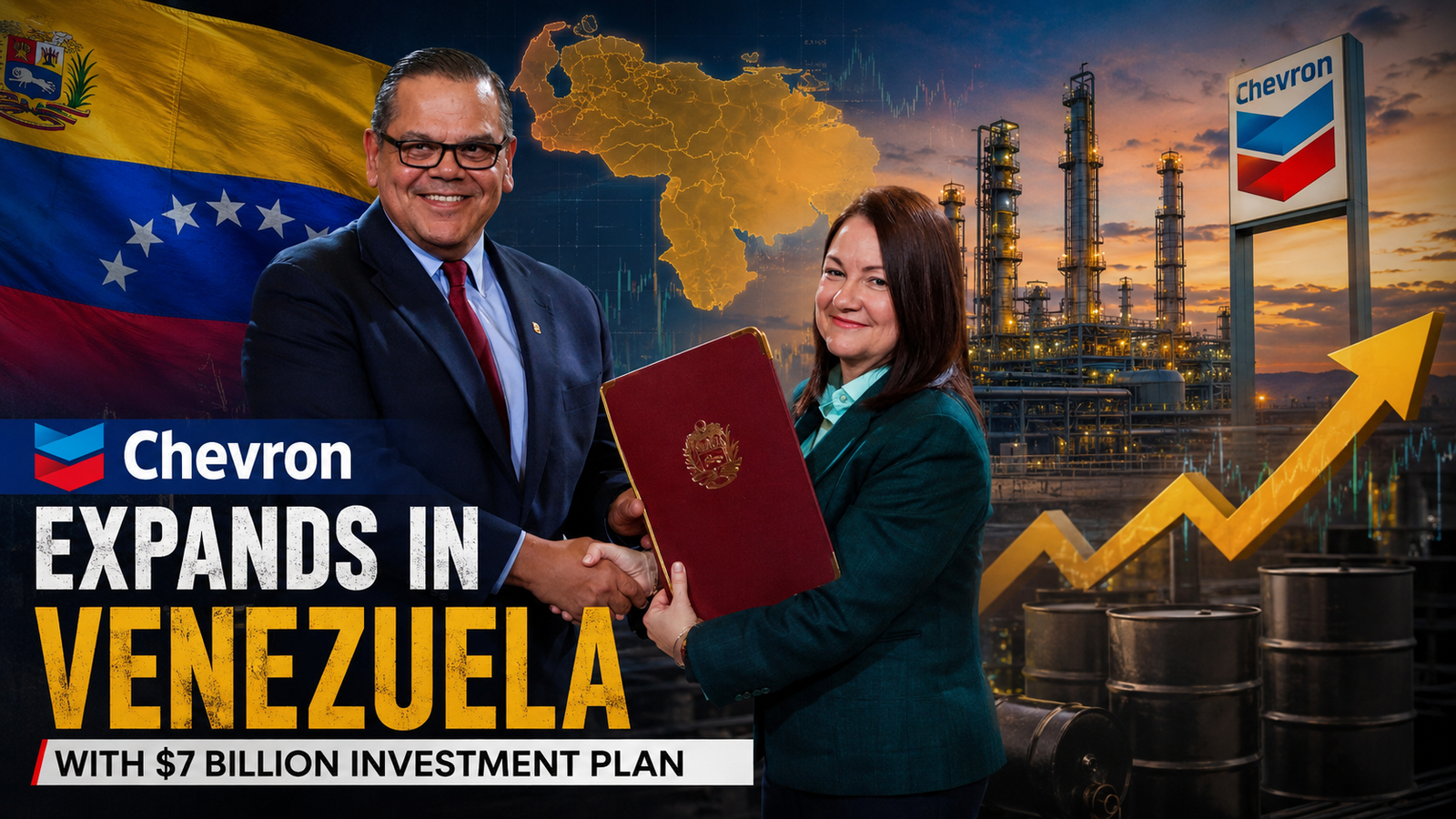
Chevron Expands in Venezuela With $7 Billion Investment Plan
The Chevron Expands in Venezuela development marks a major new phase for the U.S. energy giant as it moves to significantly increase its oil operations in the South American country. Chevron has agreed to updated terms for its Venezuelan joint ventures and plans to invest more than $7 billion over the next five years.
The company aims to more than double production from its Venezuelan joint ventures to approximately 600,000 barrels per day, highlighting its growing confidence in the country’s vast oil resources.
The announcement comes amid major changes in Venezuela’s energy sector and a broader push by the U.S. administration to attract international investment into the country’s oil industry.
Chevron Gets Additional Acreage in Orinoco Belt
A key part of the expansion is Chevron’s access to additional acreage in Venezuela’s Orinoco Belt, one of the world’s most important heavy-oil regions.
Chevron’s Petroindependencia joint venture, in which its subsidiary holds a 49% interest, has received rights to develop the adjacent Carabobo-1 and Carabobo-2-South-A areas. These new areas will expand Chevron’s existing footprint and support additional extra-heavy oil production.
The company already operates three joint ventures in Venezuela, making it the only major U.S. oil producer with a significant continuing presence in the country.
$7 Billion Investment to Boost Production
Under the new agreements, Chevron plans to invest over $7 billion between 2026 and 2031.
The investment is designed to increase production from its Venezuelan operations to around 600,000 barrels per day, more than twice its 2026 level. Chevron also expects total costs to remain below $20 per barrel, according to the company.
Chevron said the updated agreements provide improved fiscal, commercial and legal terms, creating conditions for additional investment and long-term production growth.
Venezuela Becomes Increasingly Important for U.S. Energy Strategy
The Chevron Expands in Venezuela announcement comes as Washington pushes for greater American involvement in Venezuela’s energy industry.
The broader U.S.-Venezuela energy developments include a controversial agreement involving North American Blue Energy Partners and access to 17 major oilfields. Venezuela’s National Assembly backed that agreement on September 1.
However, Chevron’s expansion was negotiated separately from that Washington agreement. Reuters reported that Chevron’s discussions with Venezuela had been underway for several months as part of broader changes to the country’s energy contracts.
Chevron’s Production Has Already Increased
Chevron’s Venezuelan operations have continued to grow even before the latest expansion.
The company said production across its three Venezuelan joint ventures has increased by approximately 15% so far in 2026. The new acreage and revised operating terms are expected to provide further room for growth.
For Chevron, Venezuela represents a significant opportunity because of the country’s enormous oil resource base and the potential to expand existing infrastructure rather than building an entirely new production system.
Why the Orinoco Belt Matters
The Orinoco Belt contains some of Venezuela’s largest oil resources and has long been central to the country’s energy industry.
Much of the oil in the region is extra-heavy crude, meaning it requires specialised technology and infrastructure to produce, process and transport.
Chevron’s existing experience in Venezuela gives it an advantage as the company expands into additional areas.
The company has maintained operations in Venezuela for more than a century, giving it a long-established workforce, infrastructure network and knowledge of the country’s oil fields.
Other Energy Companies Are Also Expanding
Chevron is not the only international energy company moving deeper into Venezuela.
Italy’s ENI also signed agreements with Venezuela on September 2 covering oil project expansions. The agreements are part of wider efforts to migrate energy contracts to new terms under Venezuela’s oil-sector reforms.
The participation of major international energy companies suggests that Venezuela is attempting to reposition its oil industry to attract foreign capital, technology and expertise.
A Major Test for Venezuela’s Oil Industry
Despite the investment potential, significant challenges remain.
Venezuela’s oil industry has suffered from years of declining production, infrastructure deterioration, political instability and international sanctions. Rebuilding production capacity will require substantial capital and improvements across the country’s oil infrastructure.
Chevron’s planned investment could therefore become an important test of whether Venezuela can successfully restore its energy sector while attracting long-term foreign investment.
The company is also entering a complicated geopolitical environment, with Washington playing a much more direct role in Venezuela’s energy future.
What Chevron’s Expansion Means for Global Oil Markets
If Chevron successfully increases production toward 600,000 barrels per day, the additional supply could become significant for global oil markets.
However, the production increase will take several years rather than appearing immediately. The company has set a five-year investment horizon for its expansion.
Greater Venezuelan production could eventually strengthen supplies to the United States and other markets, while also generating additional revenue for Venezuela’s recovering economy.
The scale of the opportunity is one reason the latest Chevron announcement is attracting attention well beyond the energy industry.
Chevron Signals Long-Term Confidence
Chevron Chairman and CEO Mike Wirth said the company’s expanded position reflects confidence in Venezuela’s resource potential and its ability to compete for investment over the long term.
The announcement represents a significant commitment from a major U.S. energy company at a time when Venezuela is attempting to rebuild its oil sector and attract international investors.
For Chevron, the strategy combines access to additional reserves with existing infrastructure and established operations, potentially allowing the company to increase production while keeping costs under control.
Key Takeaway
The Chevron Expands in Venezuela move includes more than $7 billion in planned investment over five years, additional acreage in the Orinoco Belt and a target of approximately 600,000 barrels per day in production. The expansion comes as Venezuela undergoes major energy-sector reforms and the United States pushes for greater investment in the country’s oil industry.
FAQs
1. What is the Chevron expansion in Venezuela?
Chevron has agreed to updated terms for its Venezuelan joint ventures and plans to invest more than $7 billion over the next five years.
2. How much oil does Chevron expect to produce in Venezuela?
Chevron is targeting approximately 600,000 barrels of oil per day from its Venezuelan joint ventures.
3. How much will Chevron invest in Venezuela?
Chevron plans to invest more than $7 billion over the next five years.
4. Where is Chevron expanding its Venezuelan operations?
The company has received additional acreage in Venezuela’s Orinoco Belt, including rights to develop the Carabobo-1 and Carabobo-2-South-A areas.
5. What is the Orinoco Belt?
The Orinoco Belt is a major oil-producing region in Venezuela containing vast quantities of extra-heavy crude.
6. Does Chevron already operate in Venezuela?
Yes. Chevron has maintained operations in Venezuela for more than a century and currently operates through three joint ventures.
7. Why is Chevron expanding in Venezuela now?
The expansion follows improved fiscal, commercial and legal terms for Chevron’s joint ventures and broader reforms aimed at attracting investment into Venezuela’s energy sector.
8. Will Chevron’s expansion immediately increase oil supply?
No. The company expects the production increase to take place over several years as its investment and development projects progress.
9. Are other international energy companies investing in Venezuela?
Yes. Italy’s ENI has also signed agreements with Venezuela for oil project expansions.
10. Why is Chevron’s Venezuela expansion important?
The investment could significantly increase Venezuelan oil production, strengthen Chevron’s position in the country’s energy sector and contribute to broader efforts to rebuild Venezuela’s oil industry.
