
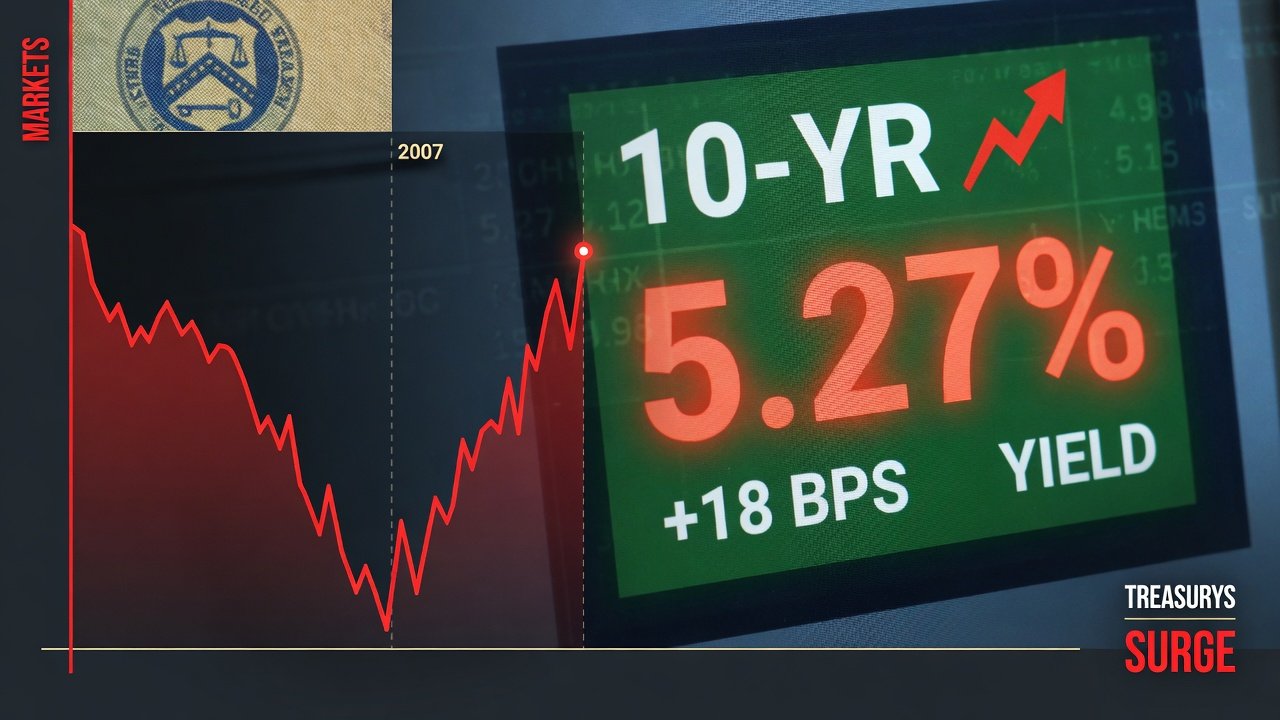
Treasury Yields Hit 2007 Highs as 10-Year Note Surges to 5.27%
Treasury yields hit 2007 highs as the benchmark 10-year U.S. Treasury yield climbed to 5.27% on September 28, 2026, reaching levels last seen in 2007. The sharp rise in borrowing costs added pressure to stocks and other risk-sensitive assets as investors assessed persistent inflation concerns, elevated oil prices and expectations for further Federal Reserve tightening.
The move marked another significant development in a bond-market selloff that has pushed U.S. government borrowing costs sharply higher during September.
10-Year Treasury Yield Reaches 5.27%
The 10-year Treasury yield briefly climbed to 5.27% on Monday before easing to around 5.23% by the close. The level represented the highest point since 2007, before the global financial crisis sent U.S. bond yields sharply lower.
The increase was significant because the 10-year Treasury is a key benchmark for borrowing costs across the U.S. economy. Its yield influences mortgage rates, corporate borrowing and the valuation of financial assets.
Reuters also reported that the 10-year yield was at its highest level since June 2007, while the 30-year Treasury yield reached its highest level since May 2004.
Why Are Treasury Yields Rising?
Several factors are contributing to the recent increase in Treasury yields.
One major factor is the renewed rise in energy prices. Higher crude oil prices have increased concerns that inflation could remain elevated for longer, potentially requiring the Federal Reserve to keep interest rates higher or raise them further.
The U.S. economy has also continued to show resilience, reducing expectations for an immediate decline in borrowing costs. Reuters reported that markets were increasingly pricing in another Federal Reserve rate increase, with investors watching upcoming inflation and employment data for clues about the central bank’s next steps.
Concerns about the scale of U.S. government borrowing have also contributed to pressure in the Treasury market. Higher government debt issuance can increase the supply of bonds that investors need to absorb, particularly when demand is sensitive to yields and fiscal concerns.
Oil Prices Add to Inflation Pressure
The bond-market move has occurred alongside heightened volatility in crude oil prices.
Brent crude remained above $100 a barrel during parts of Monday’s trading session as uncertainty surrounding the conflict involving Iran affected expectations for energy supplies and tanker movements through the Strait of Hormuz. U.S. crude settled at $92.60 a barrel, while Brent settled at $105.28, according to Reuters.
Higher energy prices can feed into inflation through fuel, transportation and production costs. That creates a difficult environment for central banks because inflationary pressure can persist even when higher interest rates are already weighing on economic activity.
Higher Yields Put Pressure on Stocks
The rise in Treasury yields contributed to a weaker U.S. stock market on September 28.
The S&P 500 fell 0.8%, the Dow Jones Industrial Average declined 0.7%, and the Nasdaq Composite dropped 0.9%. The Nasdaq’s larger decline reflected pressure on technology and growth stocks, which can be particularly sensitive to changes in interest rates.
Higher Treasury yields can make government bonds more attractive relative to equities. At the same time, higher discount rates can reduce the present value investors assign to future corporate earnings.
This effect can be particularly relevant for companies whose valuations depend heavily on expectations of strong earnings growth in future years.
Borrowing Costs Rise Across the Economy
The impact of higher Treasury yields extends beyond financial markets.
The 10-year Treasury yield is closely connected to several consumer and business borrowing rates. When benchmark yields rise, borrowing costs can increase for mortgages, corporate debt and other forms of financing.
Higher borrowing costs can affect household decisions as well as corporate investment. Companies may face greater expenses when issuing or refinancing debt, while consumers can encounter higher financing costs for major purchases.
The Associated Press noted that the rise in Treasury yields is making borrowing more expensive while putting pressure on stock and other investment valuations.
30-Year Treasury Yield Also Hits Long-Term High
The rise was not limited to the 10-year Treasury.
The 30-year Treasury yield reached 5.55%, its highest level since 2004. Longer-term yields are particularly important for mortgage markets and long-duration borrowing.
The simultaneous rise in 10-year and 30-year yields highlights the broader nature of the Treasury selloff rather than a move limited to one maturity.
Meanwhile, the two-year Treasury yield, which is more sensitive to expectations for Federal Reserve policy, approached 5%. Reuters reported that the two-year yield reached 4.937% on Monday.
Federal Reserve Rate Expectations in Focus
Markets are closely watching the Federal Reserve as higher inflation expectations influence interest-rate forecasts.
The combination of elevated oil prices, resilient economic activity and rising yields has increased expectations for another rate increase. Reuters reported that markets were pricing in growing odds of an October rate hike, with the latest estimates moving above 70% on September 29.
Upcoming economic data, particularly inflation and employment figures, could therefore play an important role in determining how investors assess the Fed’s policy path.
The Personal Consumption Expenditures price index and the monthly employment report are among the key indicators investors are watching this week.
Impact on Gold and Other Risk Assets
The rise in Treasury yields has also affected assets beyond equities.
Gold prices came under pressure as higher U.S. yields increased the opportunity cost of holding the non-yielding metal. Reuters reported that gold fell sharply on September 28 as Treasury yields climbed and expectations for further Federal Reserve rate increases strengthened.
Higher yields can also support the U.S. dollar by making dollar-denominated assets more attractive to international investors. On September 29, the dollar remained near a two-month high as rising Treasury yields and oil prices supported the currency.
Bond Market Enters a Period of Higher Volatility
The latest move is part of a broader deterioration in the U.S. Treasury market during September.
Reuters reported that two-year Treasury yields had risen by almost 60 basis points during the month and that global government bond markets were heading toward one of their weakest months in years. The combination of higher energy costs, inflation concerns and expectations for interest rates staying elevated has reshaped market expectations.
The development has also raised questions about how long borrowing costs can remain elevated before tighter financial conditions begin to slow economic activity.
What Investors Are Watching Now
Markets are now focused on three major areas: inflation data, Federal Reserve policy and energy prices.
If oil prices remain elevated, inflation could prove more persistent and keep pressure on central banks to maintain tighter monetary policy. Conversely, a meaningful decline in energy prices or weaker economic data could reduce expectations for additional rate increases.
The next round of U.S. economic data is therefore likely to receive heightened attention as investors assess whether the latest Treasury-yield surge represents a temporary spike or part of a longer period of higher borrowing costs.
Key Highlights
- The 10-year U.S. Treasury yield reached 5.27% on September 28.
- The yield subsequently eased to around 5.23%.
- The level was the highest since 2007.
- The 30-year Treasury yield reached 5.55%, its highest level since 2004.
- The two-year Treasury yield approached 5%.
- Higher oil prices have increased concerns about persistent inflation.
- Rising Treasury yields have pressured U.S. stocks and other risk assets.
- Markets are increasingly pricing in the possibility of another Federal Reserve rate increase.
- Upcoming U.S. inflation and employment data could influence expectations for monetary policy.
Frequently Asked Questions
1. What happened to Treasury yields in September 2026?
U.S. Treasury yields rose sharply during September, with the 10-year yield reaching levels not seen since 2007.
2. How high did the 10-year Treasury yield reach?
The 10-year Treasury yield briefly reached 5.27% on September 28, 2026, before easing to about 5.23%.
3. Why are Treasury yields rising?
Higher inflation concerns, elevated oil prices, expectations for additional Federal Reserve rate increases, strong economic activity and concerns surrounding U.S. government borrowing have contributed to the rise.
4. Why is the 10-year Treasury yield important?
The 10-year Treasury is a major benchmark for financial markets and influences borrowing costs for mortgages, businesses and other forms of credit.
5. How do higher Treasury yields affect stocks?
Higher yields can make bonds relatively more attractive and increase discount rates used to value future corporate earnings, putting pressure on equity valuations.
6. What happened to the 30-year Treasury yield?
The 30-year Treasury yield climbed to 5.55%, reaching its highest level since 2004.
7. Are higher oil prices linked to rising Treasury yields?
Higher oil prices can increase inflation expectations, which may contribute to expectations for tighter monetary policy and higher interest rates.
8. What is happening with Federal Reserve rate expectations?
Markets have increased expectations for another rate increase, with investors watching inflation and employment data for further signals about the Fed’s policy direction.
9. How have higher Treasury yields affected gold?
Rising yields have put pressure on gold because the metal does not generate interest income, making it relatively less attractive when bond yields increase.
10. What should investors watch next?
Investors are closely monitoring U.S. inflation data, employment figures, Federal Reserve communications, Treasury-market demand and developments affecting crude oil prices.
