
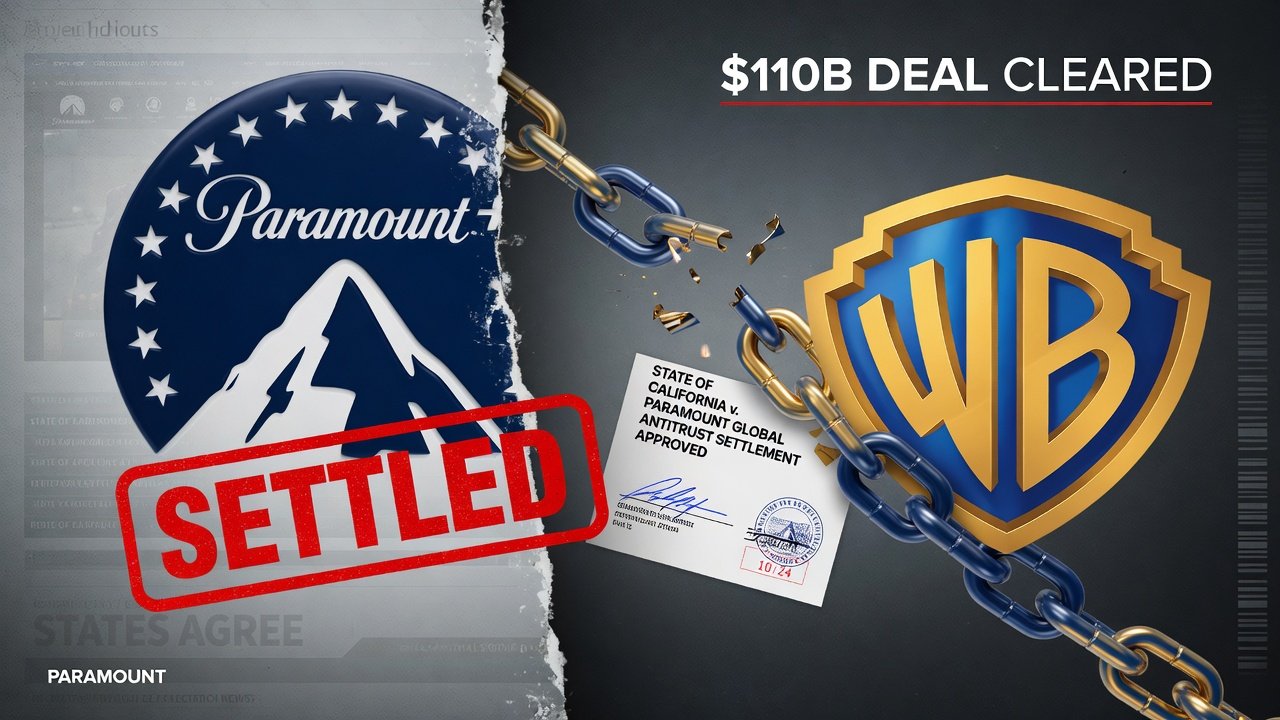
Paramount Settles With US States, Clearing Key Hurdle for $110 Billion Warner Bros Deal
Paramount Skydance has reached a major settlement with a coalition of 12 US states and the Writers Guild of America (WGA), removing a significant legal obstacle to its proposed $110 billion acquisition of Warner Bros. Discovery.
The settlement, announced on September 21, 2026, resolves the antitrust lawsuit brought by California and 11 other states against the transaction. The agreement still requires court approval, but it substantially changes the legal position surrounding one of the largest proposed media combinations in Hollywood history.
The development is particularly important because Paramount had faced a $7 million-per-day ticking fee if the transaction remained unfinished after September 30. The settlement therefore comes just days before that financial deadline.
Paramount Reaches Settlement With 12 States
The settlement was reached between Paramount Skydance and attorneys general from 12 states led by California.
The states had challenged the Warner Bros. Discovery transaction, arguing that the combination could reduce competition in the entertainment industry and potentially affect consumers, workers and content production.
California Attorney General Rob Bonta announced that the settlement resolves the states’ litigation, while emphasizing that the agreement itself does not constitute an endorsement of the merger. The settlement includes several legally enforceable commitments covering film production, workers, cable negotiations and media operations.
The agreement remains subject to approval by the federal court handling the litigation.
$110 Billion Warner Bros Discovery Acquisition
Paramount’s agreement to acquire Warner Bros. Discovery values the transaction at approximately $110 billion in enterprise value.
Under the merger agreement, Paramount agreed to pay $31 per share in cash for Warner Bros. Discovery. The transaction combines two major entertainment businesses with extensive film, television, streaming and news assets.
The combined company would bring together major brands and platforms including Paramount’s film and television operations, Paramount+, CBS and Warner Bros. Discovery’s Warner Bros. studio, HBO Max and CNN.
The deal is therefore considerably broader than a conventional studio acquisition and would reshape the ownership structure of several major US entertainment and media properties.
$7 Million Daily Ticking Fee Put Pressure on the Deal
One of the most immediate financial issues surrounding the transaction has been the ticking fee attached to the merger agreement.
Paramount and Warner Bros. Discovery agreed that if the transaction had not closed by September 30, 2026, Warner Bros. Discovery shareholders would receive an additional $0.25 per share per quarter, calculated daily until completion. Paramount’s filings and statements have described the resulting cost as roughly $7 million per day.
That deadline made the legal settlement particularly significant.
A prolonged court battle could have added substantial costs to the transaction while delaying the creation of the combined company.
The settlement with the states removes a major obstacle just before the September 30 deadline, although the transaction still needs to complete the remaining legal and closing requirements.
Paramount Agrees to Increase US Film Production
A central part of the settlement involves commitments to increase film production in the United States.
Paramount has agreed to an additional $1.5 billion commitment to domestic film production over five years.
The agreement also includes a court-enforceable commitment concerning film output. Paramount has agreed to release at least 30 films annually during the first two years and 32 films annually during the following three years, according to reporting on the settlement.
These commitments are intended to address concerns raised by the states regarding potential reductions in film production following the merger.
$47.5 Million Fund for Affected Workers
The settlement also contains provisions aimed at workers who could be affected by the merger.
Paramount has agreed to establish a $47.5 million fund for workers impacted by the transaction.
The worker-support provision was included in the states’ settlement announcement alongside the domestic production commitments and other conditions.
The issue of employment has been a significant part of the broader debate surrounding the proposed consolidation of Paramount and Warner Bros. Discovery because combining two large media companies could result in overlapping operations and restructuring.
Paramount Settles Separately With Writers Guild of America
Paramount also reached an agreement with the Writers Guild of America, which had separately challenged the acquisition.
The WGA agreed to settle its lawsuit, removing another legal challenge to the transaction. Under the agreement, Paramount will provide $17.5 million toward a healthcare fund and will not lay off writers at CBS News Broadcast for five years, according to reporting on the settlement.
The WGA had argued that the merger could negatively affect writers and employment conditions across the entertainment industry.
The union’s decision to settle means both the multi-state antitrust lawsuit and its separate legal challenge are no longer standing as the principal litigation barriers to the transaction.
New Oversight for CBS and CNN News Operations
Another major component of the settlement concerns the news operations of CBS and CNN.
The agreement provides for independent editorial oversight mechanisms intended to protect the editorial independence of the two major news organizations following the merger.
This provision reflects concerns surrounding the concentration of major television and news assets under one corporate owner.
Paramount already owns CBS, while Warner Bros. Discovery owns CNN. If the transaction closes, both networks would operate under the same corporate parent.
The settlement therefore includes specific measures concerning editorial governance.
Restrictions on Cable Negotiations
The states’ settlement also contains provisions concerning cable negotiations.
Paramount has agreed to restrictions on how it handles negotiations involving cable channels, with the stated objective of helping protect competition and consumer pricing.
The agreement includes measures intended to prevent the combined company from using its increased market position in ways that could negatively affect consumers.
Paramount Will Keep Los Angeles Film Lots
The settlement also addresses Paramount and Warner Bros. production facilities in Los Angeles County.
Paramount agreed not to sell or close the Paramount or Warner Bros. film production lots in Los Angeles County as part of the settlement.
The commitment is significant because Paramount’s future in California had become part of the dispute surrounding the merger.
The company had previously indicated that it was considering moving operations away from California if the legal dispute continued.
The settlement provides a commitment concerning the production lots, although it does not amount to a broader guarantee that Paramount’s corporate headquarters will remain in Los Angeles.
What the Merger Would Create
If completed, the Paramount-Warner Bros. Discovery transaction would create one of the world’s largest entertainment companies.
The combined business would control major movie studios, television networks, streaming platforms and extensive entertainment libraries.
Paramount brings brands and properties including Paramount Pictures, CBS, Paramount+ and Nickelodeon, while Warner Bros. Discovery contributes Warner Bros., HBO Max, CNN and other television and entertainment assets.
The companies have argued that the combination would create opportunities to expand streaming, improve content distribution and generate operating efficiencies.
The proposed transaction has nevertheless faced scrutiny because of the scale of the resulting media company.
Antitrust Lawsuit Created a Major Roadblock
The coalition of states filed its lawsuit to block the transaction, arguing that the merger could harm competition.
The legal challenge became a major obstacle to Paramount’s plans after a federal judge ordered Paramount to pause the acquisition process in July following arguments from the states.
The litigation subsequently continued while Paramount and the states negotiated a potential settlement.
The latest agreement resolves the states’ lawsuit, but the court still has to approve the settlement before the legal process can be considered complete.
European and UK Regulatory Approvals
The US litigation was not the only regulatory process surrounding the transaction.
Regulators in the European Union and United Kingdom had already approved the transaction subject to conditions, leaving the US litigation as one of the major remaining obstacles.
Paramount’s proposed acquisition therefore moved through multiple regulatory jurisdictions while the company continued negotiations with the US states and other parties.
The settlement announced on September 21 represents a major development in that broader approval process.
What the Settlement Means for Paramount
For Paramount, the settlement removes the principal state-level antitrust lawsuit that had threatened to delay the acquisition.
It also reduces the immediate risk of the transaction remaining unresolved beyond the September 30 deadline and triggering the daily ticking fee.
The company can now focus on completing the remaining court and transaction requirements.
Paramount CEO David Ellison has welcomed the agreement, while the states have emphasized the specific protections and commitments included in the settlement.
What the Settlement Means for Warner Bros. Discovery
For Warner Bros. Discovery, the settlement moves the company closer to completing its sale to Paramount.
The transaction was structured as an all-cash acquisition at $31 per share, subject to the terms of the merger agreement.
Completion would transfer Warner Bros. Discovery’s extensive collection of entertainment assets to Paramount and create a significantly larger combined media business.
However, the closing process still depends on court approval and the fulfillment of other transaction conditions.
What Happens Next?
The next major step is court approval of the settlement.
Once the settlement receives the required judicial approval and the remaining closing conditions are satisfied, Paramount can proceed toward completing its acquisition of Warner Bros. Discovery.
The September 30 deadline remains an important date because of the ticking fee attached to the transaction.
The settlement announced September 21 gives Paramount a significantly clearer legal path just days before that deadline, although the deal is not fully completed until the remaining legal and closing steps are finished.
Looking Ahead
The Paramount Warner Bros merger has entered a new phase after Paramount Skydance settled lawsuits brought by 12 US states and the Writers Guild of America.
The agreement includes substantial commitments covering US film production, affected workers, cable negotiations and editorial oversight at CBS and CNN. Paramount has also committed an additional $1.5 billion to domestic film production over five years and established a $47.5 million worker-support fund.
The settlement removes a major legal obstacle to the proposed $110 billion acquisition, but court approval and the remaining transaction requirements are still necessary before the merger can officially close.
With the September 30 ticking-fee deadline approaching, the coming days will determine how quickly Paramount can complete the final stages of the transaction.
If completed, the acquisition would fundamentally reshape the US entertainment landscape by bringing Paramount and Warner Bros. Discovery’s major studios, streaming services, television networks and content libraries under one corporate structure.
Frequently Asked Questions
1. What is the Paramount-Warner Bros. merger?
It is Paramount Skydance’s proposed $110 billion acquisition of Warner Bros. Discovery, structured as an all-cash transaction at $31 per WBD share.
2. Why did Paramount settle with the US states?
California and 11 other states had sued to block the transaction on antitrust grounds. The settlement resolves that litigation while imposing several commitments on Paramount.
3. How many states reached the settlement with Paramount?
A coalition of 12 US state attorneys general reached the settlement with Paramount Skydance.
4. What is the $7 million daily fee?
Under the merger agreement, if the transaction had not closed by September 30, Warner Bros. Discovery shareholders would receive a daily accrued ticking fee equivalent to approximately $7 million per day.
5. How much will Paramount invest in US film production?
The settlement includes an additional $1.5 billion commitment to domestic film production over five years.
6. What worker protections are included?
Paramount has agreed to establish a $47.5 million fund for workers affected by the merger. The separate WGA settlement also includes a $17.5 million healthcare fund and employment protections for CBS News writers.
7. What happens to CBS and CNN after the merger?
The settlement includes provisions for independent editorial oversight of CBS and CNN news operations.
8. Has the Paramount-Warner Bros merger been fully completed?
No. The settlement removes a major legal obstacle, but the agreement remains subject to court approval and other closing requirements.
9. Why is September 30 important?
September 30 is the date after which the merger’s ticking-fee mechanism becomes applicable if the transaction has not closed, creating a financial cost of roughly $7 million per day.
10. What companies and brands would be combined?
The transaction would bring together major Paramount and Warner Bros. Discovery assets, including Paramount Pictures, Paramount+, CBS, Warner Bros., HBO Max and CNN, among other entertainment and media properties.
